“The patch fixes the incident. The rebuild prevents the category.”
I want to tell you a true story.
In early 2022, my team and I launched BriskVTU — a service built for Nigerians living abroad who wanted a clean, trustworthy way to take care of their families’ utility needs back home.
Airtime. Data. Bills.

The kind of small, steady acts of care that happen across thousands of miles and matter far more than any single dollar amount attached to a transaction.
We bootstrapped the launch. No outside funding. Every dollar of operating capital came directly out of our own pockets, which becomes important very quickly in this story.
For the first few weeks, things looked promising. The platform worked. Customers were arriving. Early reviews were warm.
Then, three months in, we sat down with the numbers.
We had lost $4,000 to fraud.

Not from one dramatic incident. The losses bled out slowly across the quarter, hidden inside patterns we didn’t fully understand until weeks later.
The pattern itself was simple.
Fraudsters would fund wallets, immediately drain them through utilities like airtime, data, and bill payments, then disappear before our team could react. We would block one account, and another would appear. We tightened verification checks, and they found another seam. We added restrictions, and they routed around them.
Everything moved faster than we could.
For three straight months, we hemorrhaged money on a business that had not yet begun generating meaningful revenue.
If you’re operating inside a large corporation, $4,000 is frustrating.
If you’re bootstrapped, $4,000 is runway.
It is hosting. Infrastructure. Software tools. Operational breathing room. The difference between making it to the next quarter or quietly shutting down.
I still remember the night I texted my CTO.
“Is all of this labour even worth it?”
He called me immediately.
The conversation wasn’t dramatic. We were both exhausted. Both honest. Somewhere underneath the fatigue, I think we were relieved that the other person had finally said out loud what we had both been thinking privately.
By the end of that call, we agreed we would shut BriskVTU down the next day.
That is where this story would have ended for most teams.
And honestly, it would have been understandable.
Three months of losses. No clear path to stop the bleeding. A product the world might never notice disappearing.
But by morning, neither of us could do it.
Because underneath the spreadsheets and operational stress was the real reason we built the platform in the first place.
We knew exactly what it felt like to want to take care of people you love from thousands of miles away, only to interact with systems that made that act of care feel frustrating instead of dignified.
We were not going to let fraud kill that mission.
At the same time, we also knew with complete clarity that we could not survive another three months operating the same way.
So we called a team meeting.
We laid everything out openly: The losses. The fraud patterns. The conversation from the night before. The actual financial position of the business.
Then we made a decision that, looking back, became one of the most important decisions we have ever made as founders.
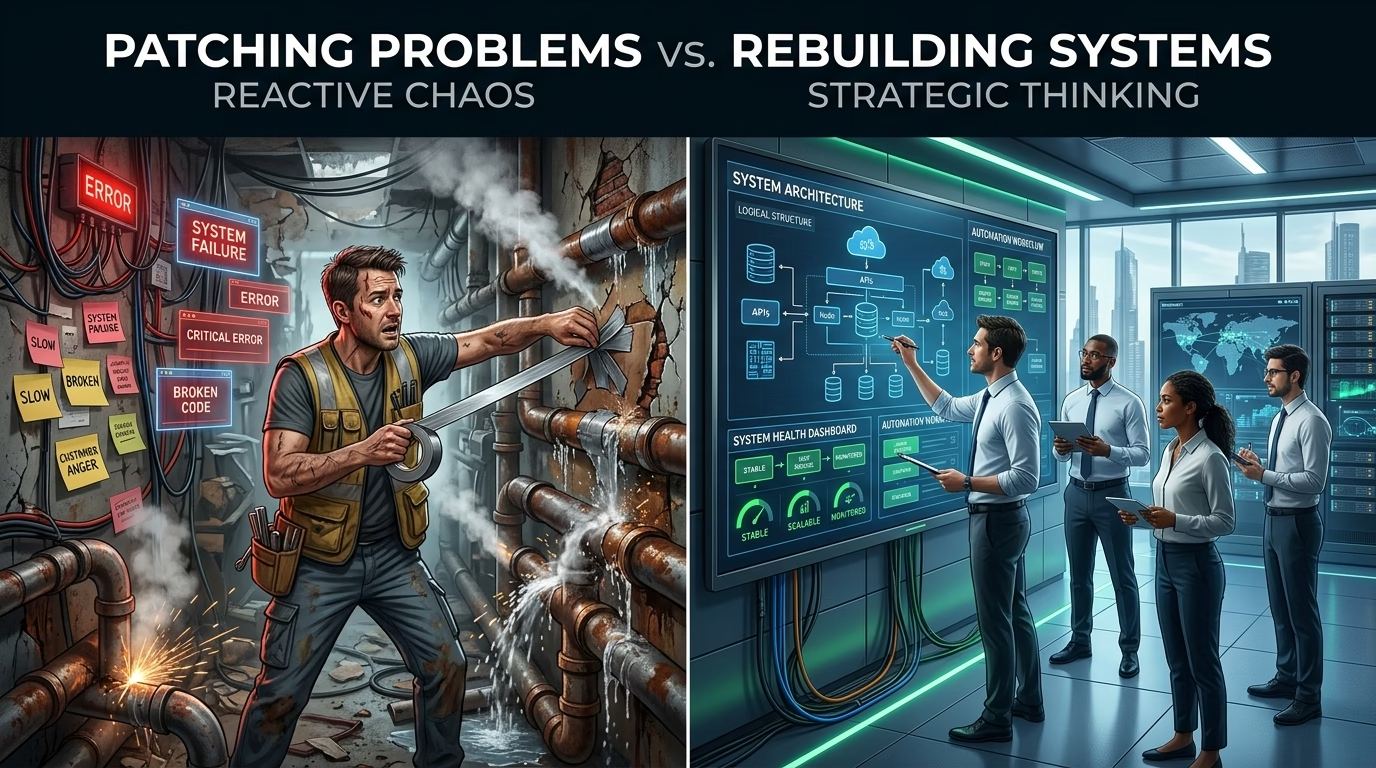
We were not going to patch the fraud.
We were going to rebuild the system.
Lesson 1: A Crisis Is Information About Your System
When something breaks inside a business, the instinct is usually immediate reaction.
Refund the angry customer.
Redo the rejected deliverable.
Block the fraudulent account.
That response matters. But it is not the real work.
The real question is this:
“What does this incident reveal about the system underneath?”
That question changes everything.
The Difference Between Incidents and Systems
Consider how this shows up across different parts of a business.
The Angry Customer
The visible issue is the complaint.
But underneath it, there is usually a systems failure:
Was the sales conversation oversold?
Did onboarding fail to frame expectations properly?
Did communication disappear during a critical phase of the project?
The Rejected Deliverable
The problem is rarely just the deliverable itself.
More often, the system underneath allowed misalignment to ship.
Was the scope ambiguous?
Was there no internal QA process?
Were you the only person reviewing the work before delivery?
The Team Member Who Quit
Most resignations feel sudden only in retrospect.
The system usually signaled the problem long before the exit happened.
Was the role unclear?
Was feedback too infrequent?
Was the workload sustainable?
The Fraud We Faced
The fraud itself was not the deepest issue.
The deeper issue was the system that allowed it to happen repeatedly.
What assumption in onboarding made the attacks possible?
What settlement timing exposed us?
What gap between detection and action allowed the damage to accumulate?
A patch resolves one event.
An unchanged system reproduces the same event over and over again.
Most founders patch symptoms.
The founders who build resilient businesses treat incidents as diagnostics.
They sit with the discomfort long enough to ask what the failure is actually revealing about the structure underneath.
Try This in Your Business This Week
The next time something breaks, pause before fixing it.
Write down two sentences:
- 1What broke?
- 2What did the system underneath have to be doing — or failing to do — for this to be possible?
The first sentence describes the incident.
The second sentence reveals the real work.
Most founders never write the second sentence.
Lesson 2: Rebuild the Category, Not the Case
Once you understand the system underneath a problem, you face a choice.
You can:
- 1Fix the specific case
- 2Rebuild the system so the entire category of problem becomes harder to repeat
Most founders choose the first option because it is faster and cheaper in the moment.
They are also the founders still fighting the same fires years later.
What “Patching the Case” Would Have Looked Like
For us, patching the fraud would have meant:
• Blocking the account
• Refunding the loss
• Tightening one verification rule
• Moving on
And six weeks later, we would have been back in the exact same conversation with a different fraudster exploiting a different seam.
What “Rebuilding the Category” Looked Like
Instead, we accepted something important:
Fraud was not a temporary interruption.
It was a permanent feature of the environment we operated in.
So we built an entirely new operational layer designed specifically to detect, monitor, and learn from fraud continuously.

Internally, we called it the Nerve Layer.
Without exposing operational details, the philosophy behind it was simple:
Detection should happen before damage, not after.
Monitoring should assume attacks can happen anytime — 3 AM, holidays, weekends, whenever vigilance is lowest.
And every month, without exception, the team reviews every attempted breach, every block, every near miss.
Not as a postmortem.
As a living intelligence system.
A continuously evolving understanding of how threats change and how the business must evolve alongside them.
The patch would have taken an afternoon.
The rebuild took weeks.
The patch would have saved a transaction.
The rebuild changed the shape of the business.
And it is one of the reasons BriskVTU is still here today, serving thousands of families across the diaspora.
The Principle Applies to Every Business
This idea extends far beyond fraud.
The late delivery is rarely just a delivery problem.
It usually signals a missing operational layer inside the delivery system.
The pricing dispute is rarely just about pricing.
It signals a sales process that allowed expectations to drift.
The burned out employee is rarely just a people problem.
It signals an unsustainable workload model or unclear role design.
The patch handles the case.
The rebuild prevents the category.
A Simple Exercise for Founders
Look at the three issues that have repeated most often in your business over the past six months.
Maybe it is:
• Late client deliverables
• Pricing disputes
• Onboarding confusion
• Difficult customer conversations
• Team communication breakdowns
Write them down.
Then ask yourself:
“Am I patching the case, or rebuilding the category?”
If your answer is “patching the case” for most of them, then there is still a missing system waiting to be built.
Your recurring problems are evidence of it.
Final Thought

“The patch fixes the incident. The rebuild prevents the category.”
Once you fully internalize that distinction, you stop spending years trapped inside recurring problems.
You begin building systems that compound instead of systems that constantly recover.
That question saved BriskVTU.
It might save the business you are building too.
— Destiny